Pittsburgh Flagpole Crew provides flagpole installation and repair for homeowners, businesses and public buildings across the greater Pittsburgh area. We install wall-mounted, telescoping and fiberglass flagpoles at front porches, yards and storefronts. Our repairs address frayed halyards, worn pulleys, faded finishes and missing ball toppers, and range from a re-rope to a full pole replacement. Contact us for a free quote today.
How Do You Tell When a Flagpole Actually Needs Repair or Replacement?
Start at the base. Push firmly on the pole with one hand. If it moves at the ground, the footing or sleeve has a problem, and that's not something to leave through another windy season. Other trouble usually shows up higher on the pole or in how the flag behaves, and each pattern points to a different failing part, so it's worth knowing all of them before anyone climbs a ladder. Most poles show one or two of these signs long before anything breaks.
- Halyard rope fraying, fuzzing, or going stiff
- Truck pulley at the top squealing or refusing to turn
- Pole leaning or rocking at the ground line
- Rust bubbling or pitting where the pole meets the ground
- Flag repeatedly wrapping around the pole in wind
Why Does the Halyard Rope Fray So Much Faster Than the Rest of the Pole Wears?
The halyard is the only part that moves every time the flag goes up or down, and it rides over the same few inches of pulley sheave and cleat all year. Most residential halyards are braided polyester or nylon. Sunlight breaks down the outer braid first, which is why the rope turns fuzzy, chalky, and stiff long before it snaps. Rope that slaps against an aluminum pole in wind also gets chewed wherever it hits the shaft, so the frayed spots tend to appear at the same heights every time. Replace the halyard as soon as the inner core shows through the braid, and check the cleat while you're at it. A burr or sharp casting edge on the cleat will shred a brand-new rope within a single season.
Does a Truck Pulley That Won't Turn Mean the Whole Flagpole Has to Come Down?
Usually not, though someone does have to reach the top. The truck is typically a cast aluminum or plastic housing with a small sheave spinning on a pin. Grit, a corroded pin, or a cracked plastic sheave is what locks it up or makes it squeal. On sectional and telescoping poles, the top section lifts off so the truck can be cleaned or swapped on the ground. On a one-piece ground-set pole, the job calls for a bucket lift or climbing rig, not pulling the pole from its sleeve. In the meantime, don't keep hauling the flag over a frozen sheave. Rope dragging across a stationary wheel saws itself apart, and it can jump the groove and jam solid, leaving the flag stuck at the top until someone goes up after it.
Can a Leaning Flagpole Just Be Pushed Back Straight and Packed With Gravel?
Only if the lean comes from the pole sitting loose in a correctly set sleeve, and even then the fill should be dry sand, not gravel. A properly installed ground-set pole sits in a steel or PVC sleeve embedded in a concrete footing, with sand packed between pole and sleeve and wooden or steel wedges at the top holding it plumb. If the lean comes from the footing itself, meaning concrete poured too shallow, cracked, or set in soil that heaves with frost, repacking only holds until the next storm or freeze-thaw cycle. Put a level on two faces of the pole and inspect the concrete collar closely. If the collar is cracked or tilted along with the pole, the footing has to be dug out and repoured.
What Is Happening When Rust Bubbles Up Where the Pole Meets the Ground?
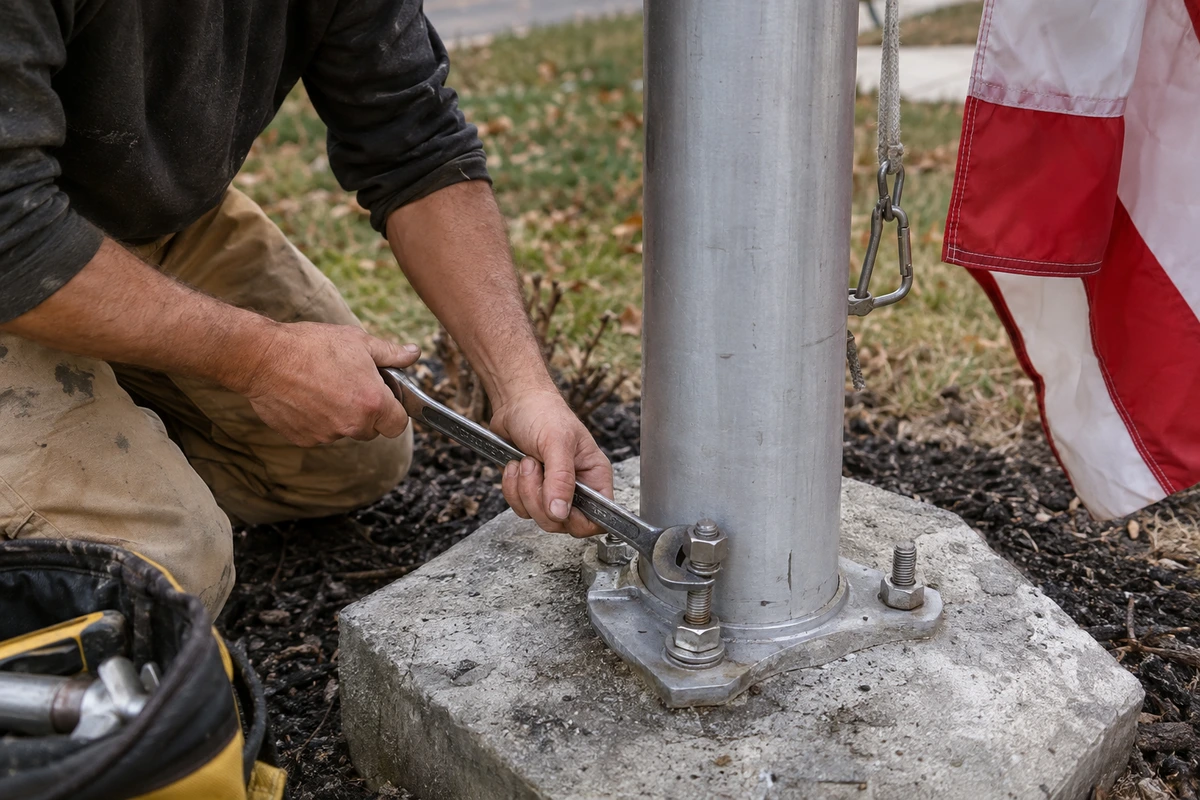
That's corrosion working from the inside out, where moisture gets trapped between the pole and its sleeve or collar and never fully dries. On steel poles it's ordinary rust lifting the paint. On aluminum it appears as white, powdery pitting, often worst where the aluminum touches a steel sleeve or steel wedges, setting up galvanic corrosion between the two metals. The ground line also takes the most bending stress in wind, so thinning metal there is exactly where a pole snaps. Probe the bubbled area with a screwdriver. If surface scale flakes off over solid metal, you can wire-brush, prime, and seal it, then add a caulked collar to shed water. If the tip punches through or the wall flexes, the pole needs replacing.
Will a Heavier Flag Stop It From Wrapping Around the Pole?
No. A heavier flag actually winds itself tighter and is harder to free once it wraps. Wrapping happens because the flag is clipped to fixed snap hooks on a halyard that can't follow the wind, so every time gusts shift direction, the fly end winds a little further around the shaft. The fix is hardware, not fabric: a rotating truck at the top, or rotating mounting rings that let the flag swing a full circle, plus swivel snaps in place of plain ones. Left wrapped for days, the flag wears through where it rubs the pole, and the halyard gets pinched against the shaft, which leads straight back to the fraying problem at the top of the list.
How Much Does Flagpole Installation and Repair Cost in Upper St. Clair Township, PA?
Flagpole installation and repair in Upper St. Clair Township, PA typically runs between $302 and $3,657. A halyard swap or truck pulley replacement falls at the low end, and a new ground-set pole with a poured concrete footing falls at the high end. Pole height and material drive most of the price, since a 25-foot one-piece aluminum pole costs far more to set than a short sectional one. Site conditions add labor too, whether that means digging out a cracked footing, working in frost-heaving soil, or bringing in a bucket lift to reach the top.